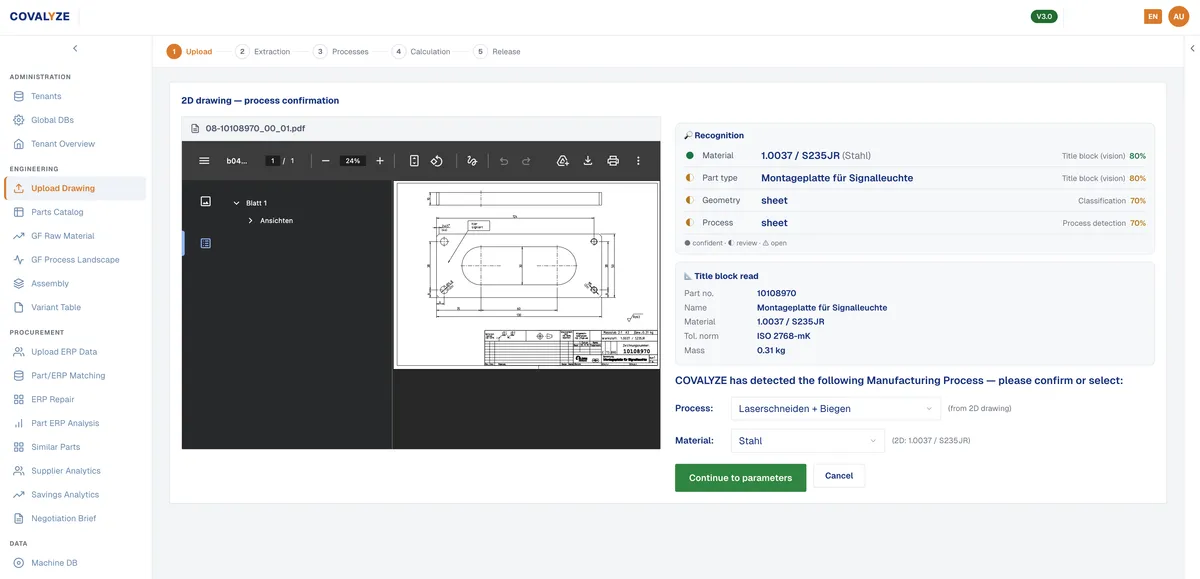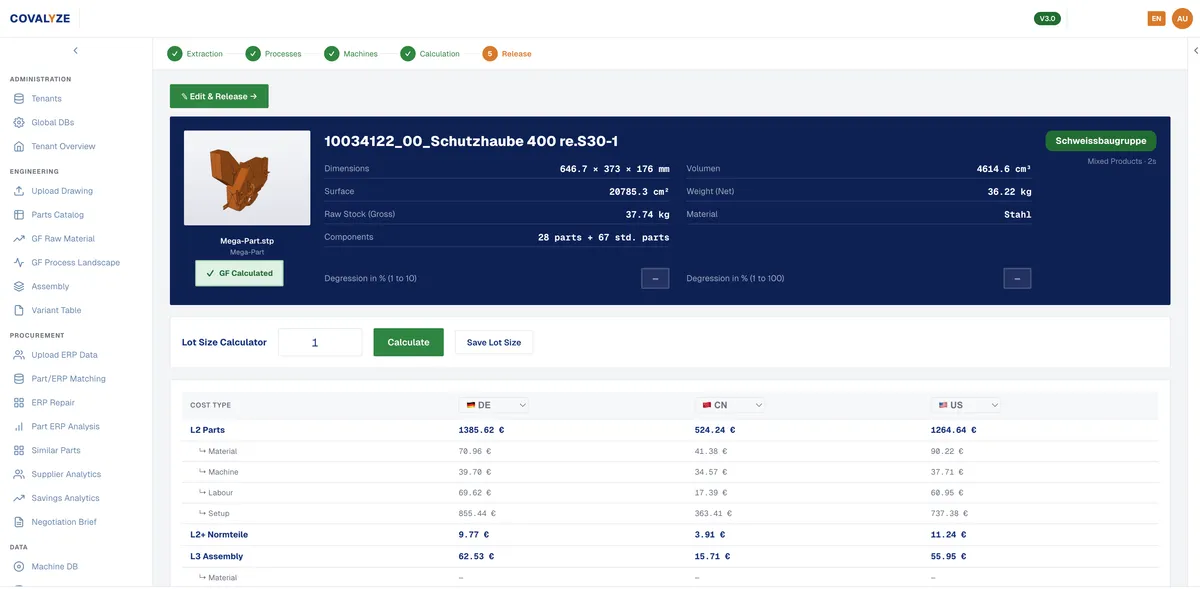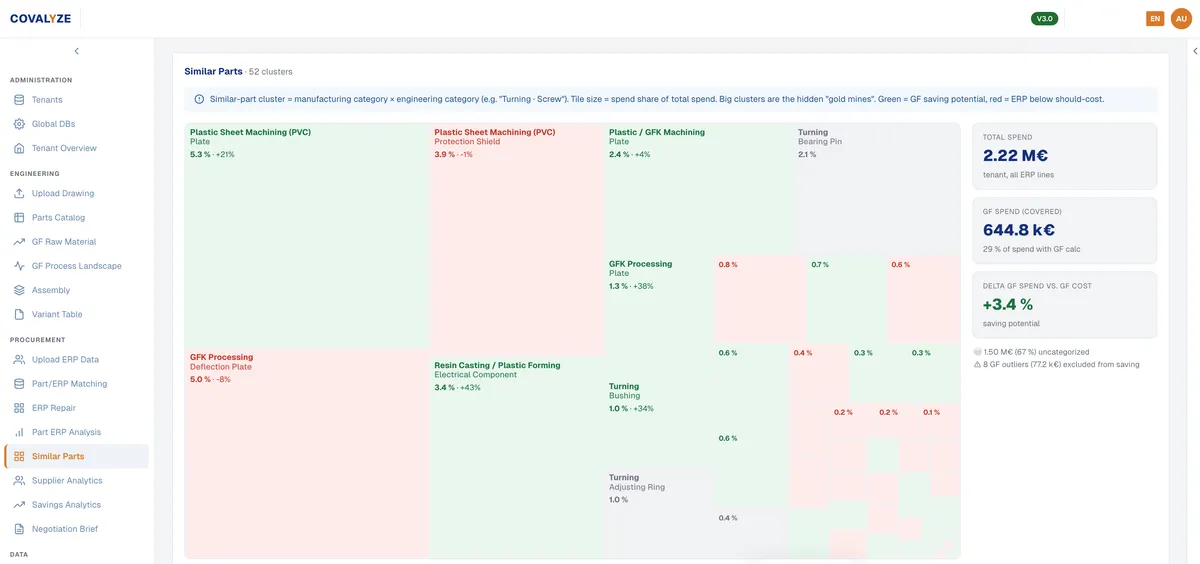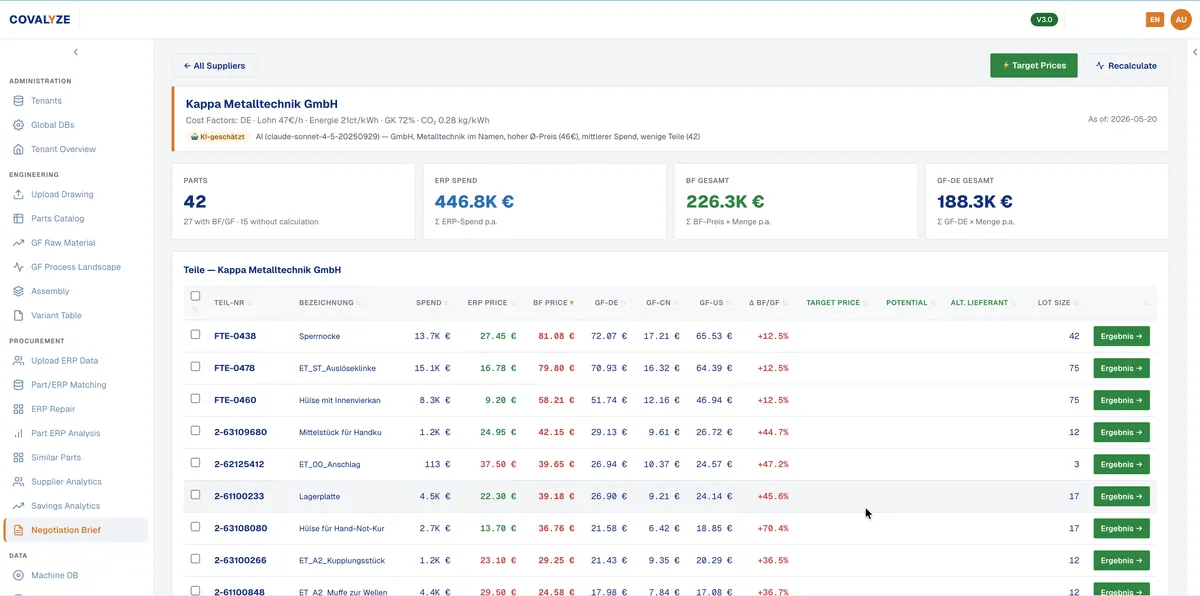
Agentic procurement is an appealing picture. Agents spot sourcing opportunities, shortlist suppliers, prepare inquiries, evaluate quotations, propose a negotiation line, and get better at all of it with every cycle.
Between today's procurement processes and that picture sits a step that rarely gets discussed. Before procurement can become agentic, its outputs have to become reproducible.
RfIs, RfQs and RfPs are a good place to start. The document itself is the least interesting part of that. Writing a genuinely good RfX requires a data foundation that connects what a company buys with how the underlying part is designed, manufactured and costed.
The limitation is not the AI. It is the context available to it.
An AI can write an RFQ. That was never the hard part.
Give a language model a component description and a professional-looking RFQ comes back in seconds. It will get the structure right, use the standard clauses and lay out a response template. On its own that creates very little advantage, because writing the document was never the difficult part of a sourcing package.
The decisions that matter happen before anyone writes anything.
- Should these parts be sourced together?
- Do they require the same manufacturing technologies?
- Which supplier capabilities does the package actually need?
- Are there parts in the package that technically belong somewhere else?
- Could variants be consolidated before suppliers are approached?
- What manufacturing cost should procurement expect?
- And when quotations come back, which prices deserve a closer look?
A sourcing document that answers those questions is the output of an analysis. One that skips them is well-formatted text that a person still has to check before it can go out.
RfX is a test of procurement data readiness
Which makes RfX generation a useful maturity test for industrial procurement. Point it at the systems you already have and ask for exactly one thing:
"Create a supplier-ready RFQ for this product family."
Could it? Every piece of the answer already exists somewhere in the company. The ERP knows part numbers, suppliers, quantities and historic prices. The drawing carries material, dimensions and tolerances. Engineering knows why a particular specification is there in the first place. Manufacturing understands which processes and machines the part needs. Procurement holds the commercial history.
The pieces just live in different systems, and usually in different departments. A good RFQ needs all of them at once.
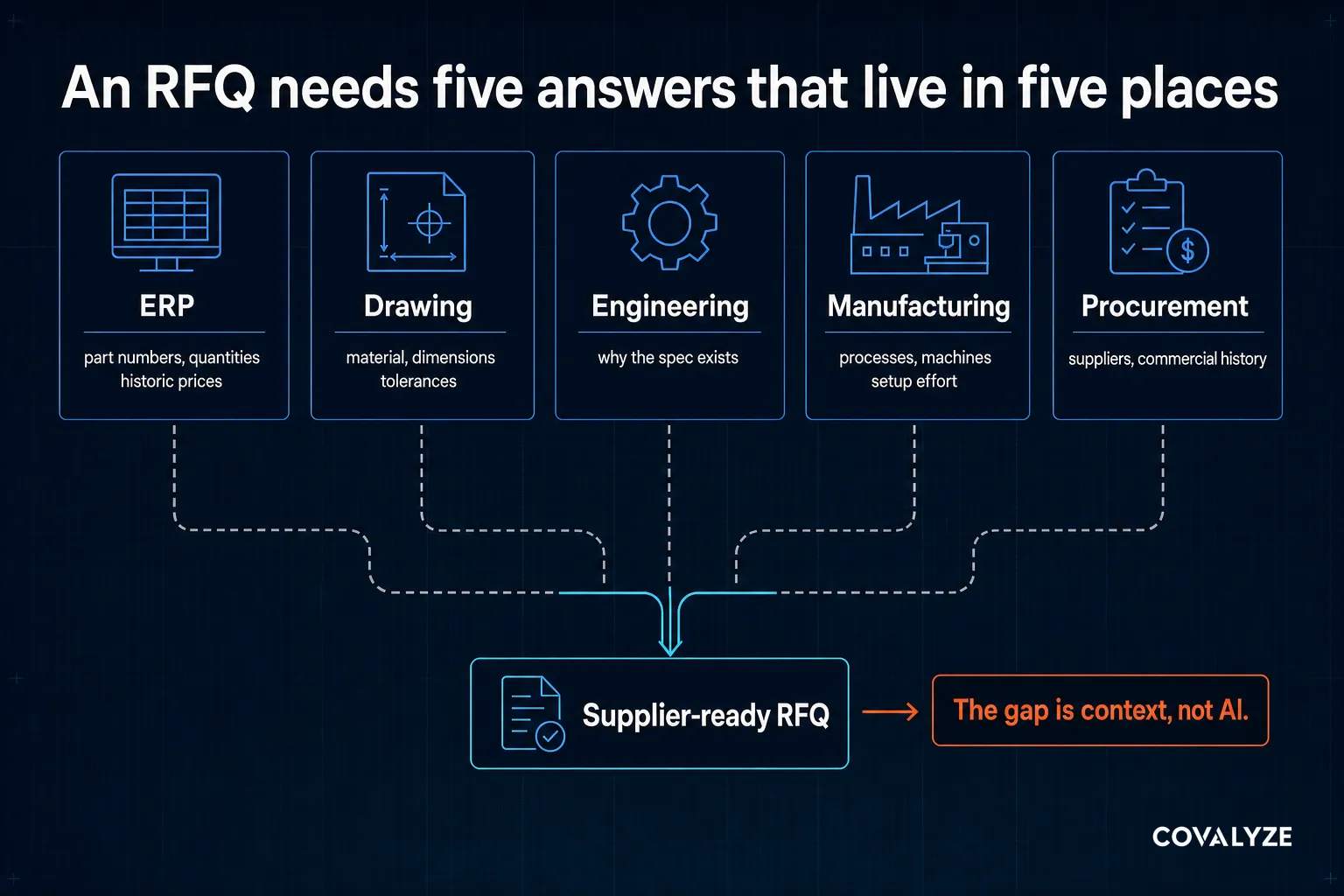
If assembling a sourcing package still takes several exports, a couple of spreadsheets, two conversations with engineering and a round of manual interpretation, an autonomous sourcing agent runs into the same wall. The difference is that it works faster and does not flag the context it never had.
Start with the output, not with the agent
So the next step towards agentic procurement is probably more pragmatic than deploying autonomous sourcing agents. Start by asking whether high-quality procurement outputs can already be generated from the data you have.
An RfX document is one example. The same principle applies to a supplier comparison, a negotiation preparation, a should-cost calculation, a sourcing recommendation or a design-to-cost opportunity list. Each of those outputs tests the same thing: whether the underlying information is structured, connected and explainable enough to stand behind a decision.
Readiness test
Both answers are useful. Only one of them means an agent has something to work with.
A one-question audit of your part data
If the system can reliably produce these outputs today, the move towards agentic workflows gets much shorter, because the agent no longer starts from fragmented source data.
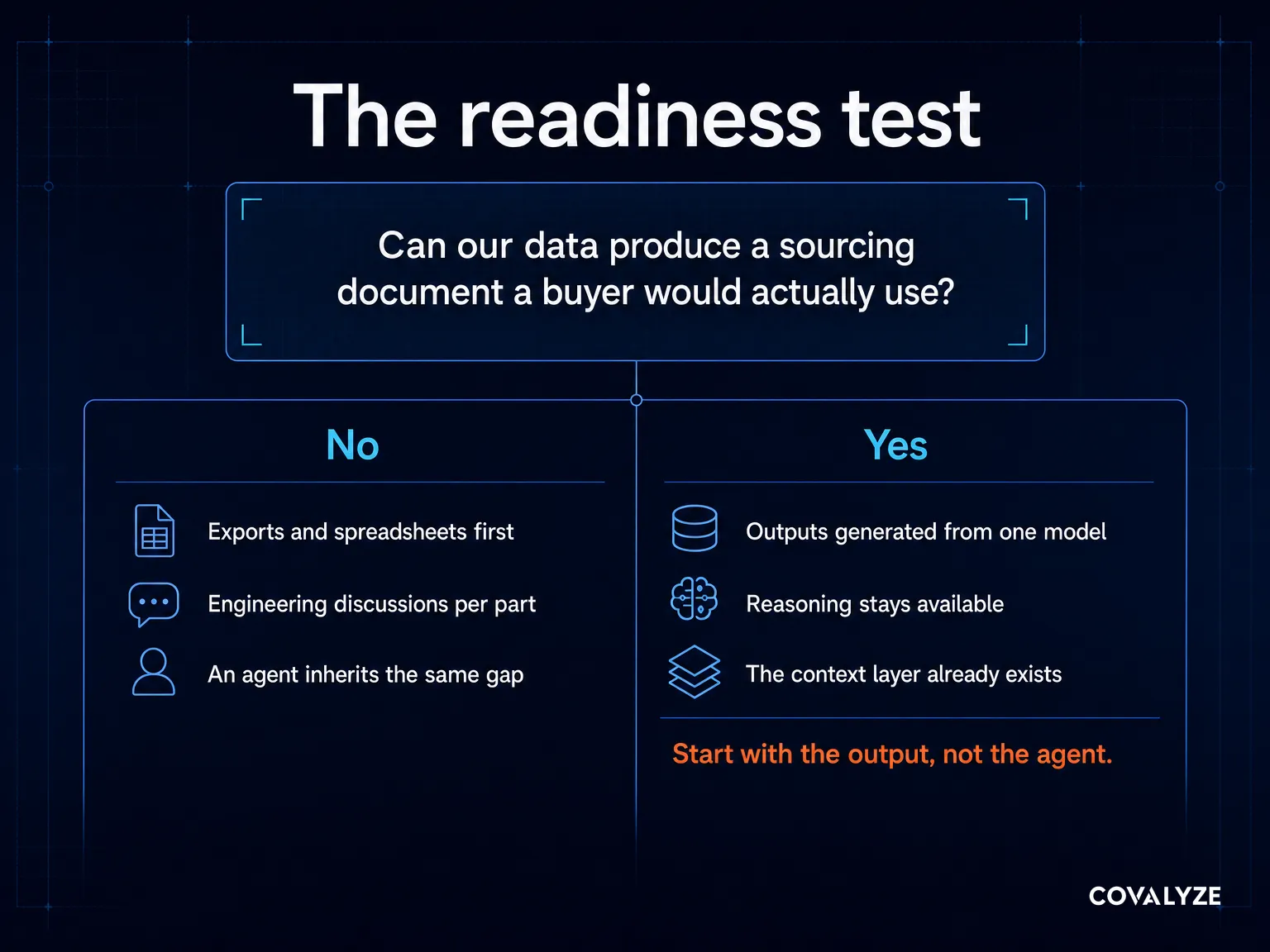
It starts from a usable technical-commercial representation of the product instead of a set of exports that still need interpreting.
That is also why the test is worth running before any agent is procured. It shows whether the gap sits in the AI layer or one level below it, and the answer points at where the work actually has to happen.
The missing connection between engineering and procurement
This matters most in direct-material procurement, where the cost sits in the part itself. A purchased component is more than a line in an ERP system. It has a material and a geometry. It requires manufacturing operations, and those operations require machines, setup time, labor, energy and production capacity. Its design decides which suppliers can make it at all, its quantity drives the manufacturing economics, and its production location sets the cost structure. All of it ends up in the supplier price.

Most organizations have split that knowledge along functional lines. Engineering owns the specification, manufacturing owns process knowledge, procurement owns suppliers and prices. Software landscapes have largely followed the same boundaries, so the systems reinforce the split instead of closing it.
For agentic procurement, those boundaries turn into a hard constraint. An agent that knows prices but does not understand the component cannot do technical sourcing. An agent that reads the drawing but does not know quantities or commercial conditions cannot evaluate a purchasing decision. Another procurement interface on top does not close that gap. What closes it is a shared data foundation underneath the systems that already exist.
Where the context breaks
The handover is still a conversation
In practice the connection between a specification and a price is made by people. A buyer asks why a tolerance is that tight, an engineer explains the assembly it goes into, and a sourcing decision follows from a ten-minute discussion.

That works, and it does not scale. The reasoning stays with the two people who had the conversation, and the next part starts the same exchange from the beginning.
An agent cannot join that conversation. It can only work from what has been written down in a form it can read, which is why the data model matters more than the interface.
What changes when the context is there
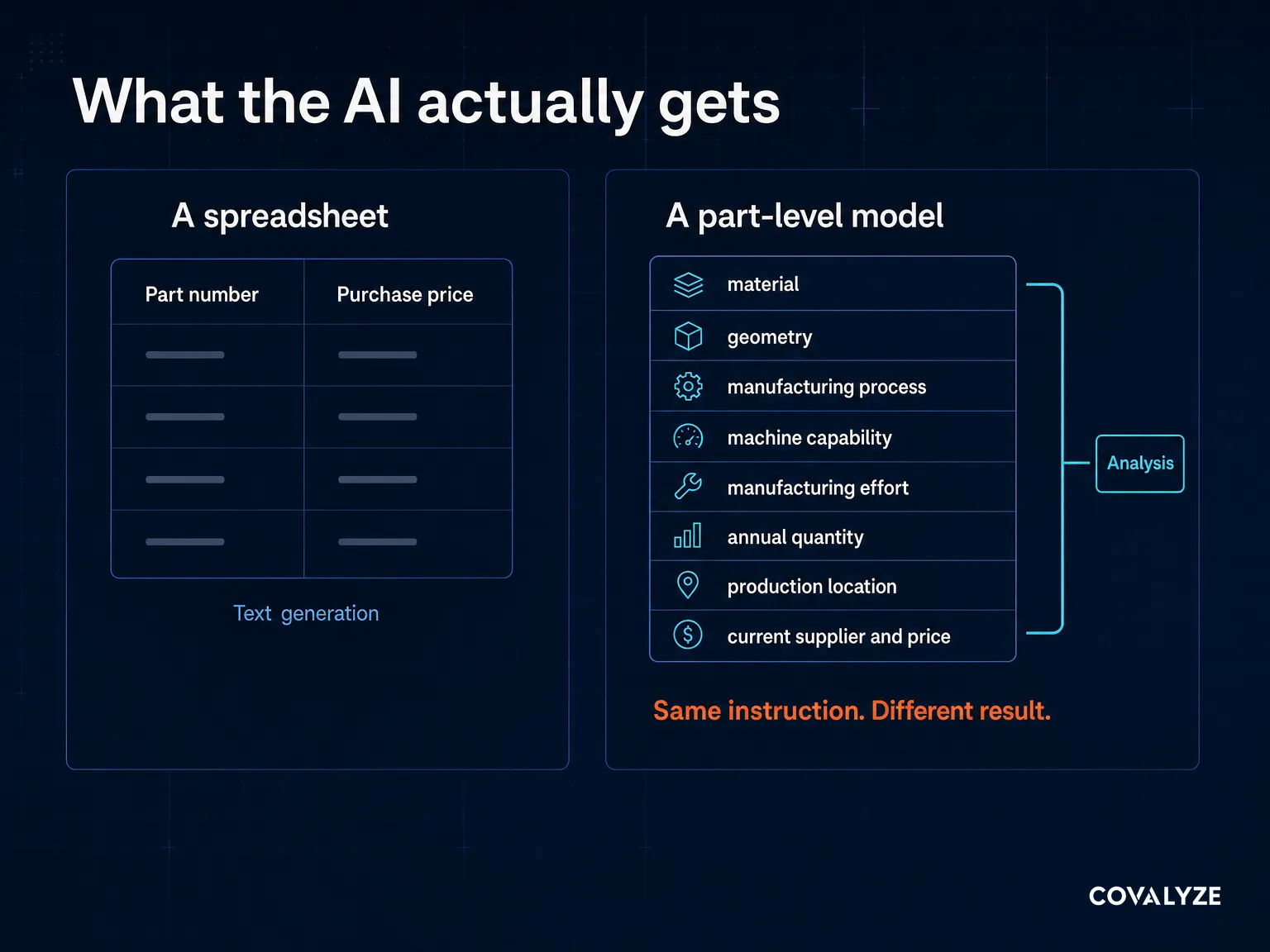
The difference shows up as soon as technical, manufacturing and commercial information are connected at part level. Instead of handing an AI a spreadsheet of part numbers and purchase prices, you can hand it:
- material and geometry
- relevant manufacturing processes
- required machine capabilities
- estimated manufacturing effort
- annual and order quantities
- production location
- current supplier
- current price
The instruction stays the same. "Prepare an RFQ" now produces a very different result.
Input quality
With a spreadsheet, the model can only write. With a part model, it can decide what belongs in the package.
Same instruction, different result
The system can identify which components logically belong together and which ones need a different supplier capability entirely.
It can flag the unusual part sitting in a package it does not fit, recommend the technical information a supplier needs in order to quote correctly, and consolidate variants before anyone is approached.
It can also attach the cost context that the quotation analysis will need weeks later. The document becomes the output of an analysis rather than the output of text generation, and that difference is what makes it worth automating.
RfX automation is the bridge, not the destination
Once the foundation exists, the RFQ is where the useful part starts. The same context carries straight into the quotations when they arrive.
The system can compare offers against existing prices and modeled manufacturing costs, show where suppliers differ significantly from each other and from the calculation, highlight which cost drivers deserve clarification, prepare the negotiation questions, and indicate whether a part should be re-sourced, redesigned, consolidated or moved to another manufacturing location.
This is the point where output automation starts becoming agentic procurement, and the shape of the workflow changes with it.
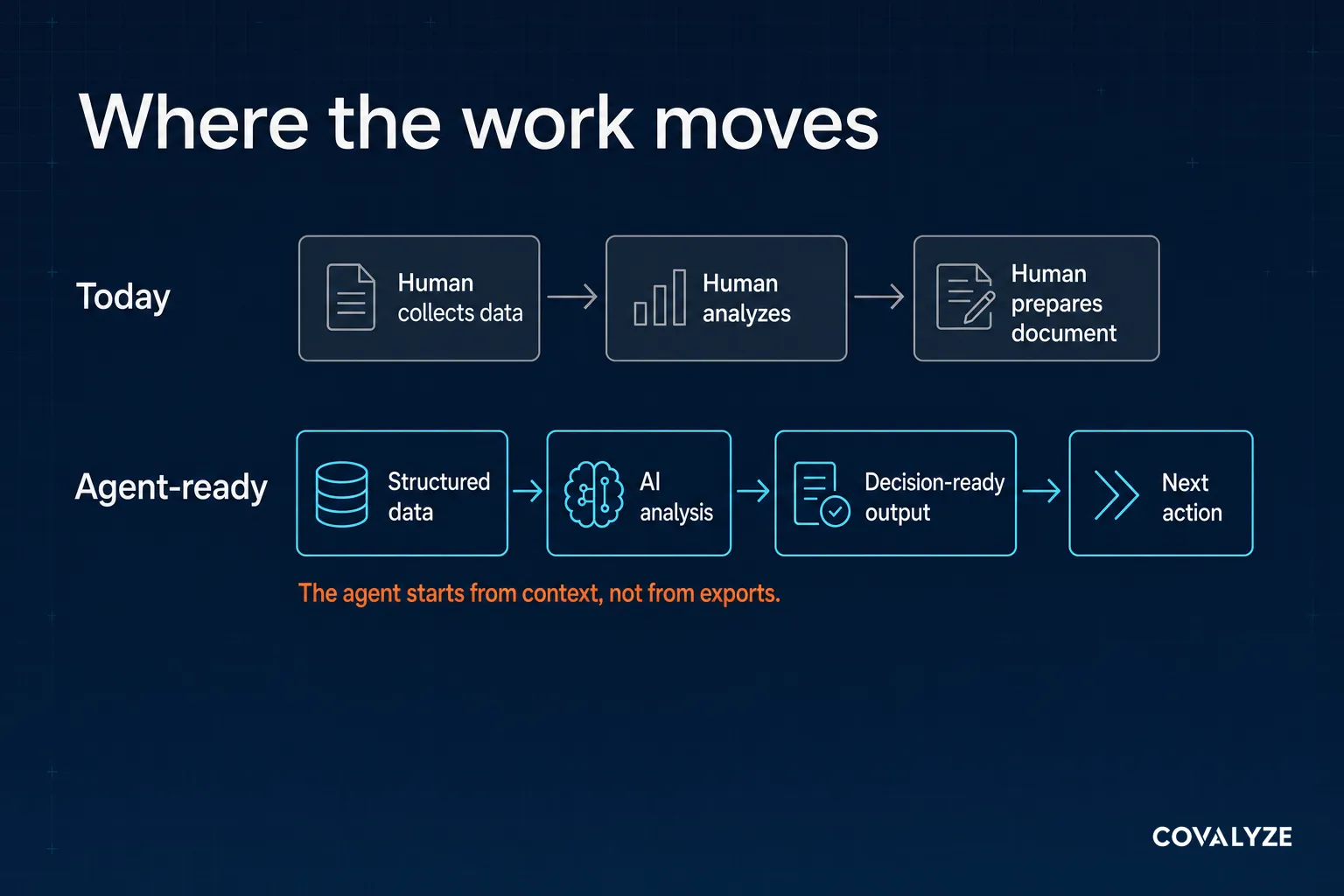
Over time, more of those actions can be connected to each other. How far it is sensible to go depends on the quality of the context underneath, which is the constraint the whole exercise started with.
What survives after the sourcing project ends
A sourcing project produces an RFQ, a set of supplier quotations, a negotiation deck and eventually a booked saving. Months afterwards, one question turns out to be surprisingly hard to answer.
Why did we make that decision?
Why did we assume that target price? Why were those parts grouped together? Why was that supplier challenged? Why did a particular manufacturing alternative look attractive at the time?
Project deliverable
What a sourcing project leaves behind
- An RFQ document and a folder of quotations
- A negotiation deck built for one meeting
- A saving booked in a controlling report
- Assumptions that lived in a consultant's model
Persistent foundation
What a data foundation leaves behind
- Cost logic that new prices can be added to
- Grouping decisions with the reasoning attached
- Target prices that can be recalculated when inputs move
- A basis the next part can be analyzed against
The same sourcing work, stored two different ways. Only the second one is still useful when the next request arrives.
When the analysis sits on a persistent data foundation, the reasoning stays available. New prices can be added, new suppliers compared, new parts analyzed with the same logic, cost assumptions updated as energy, wages and material indices move. The output does not expire with the project, and the next team does not start from zero.
An agent asked to revisit a sourcing decision needs the same history. Without it, it either repeats the original analysis from scratch or produces a confident recommendation on top of assumptions nobody can see.

COVALYZE: from part data to agent-ready context
COVALYZE builds this foundation by combining technical product information with manufacturing and commercial procurement data.
It extracts technical characteristics from drawings and other engineering sources, derives and calculates manufacturing processes and cost drivers, and takes supplier prices, quantities and sourcing information as the commercial layer. What comes out is a structured technical-commercial representation of the parts a company manufactures and purchases.
That foundation already produces decision-ready outputs: should-cost calculations, target prices, supplier analyses and RfX preparation. The longer-term value is that the same structured context can be handed to AI agents working on supplier discovery, sourcing, quotation analysis, negotiation preparation and design-to-cost.
The RfX is therefore an early milestone rather than the final product. It is one of the first visible proofs that the procurement data underneath has become usable by AI at all.

Before you go agentic, ask one question
Companies weighing up agentic procurement can start with a simple test.
Can our existing data automatically produce a sourcing document that an experienced procurement professional would actually use?
If the answer is no, adding an agent will not solve the underlying problem. The agent inherits the gap and works inside it faster.
If the answer is yes, the same data foundation that created the RfX becomes the context layer for the next procurement decision, and eventually for an agent capable of executing parts of the process on its own.
The path to agentic procurement does not start with the agent. It starts with making procurement knowledge structured, connected and capable of producing outputs that people are willing to send to a supplier.
See how COVALYZE Analytics and PartIQ turn drawings, part data and supplier prices into the technical-commercial context that RfX automation and agentic procurement both depend on.